
Turning everyday environments into opportunities for independence.
The Independent Living Training Room is Brighter Futures Foundation’s practical innovation environment: a place to explore how realistic routines, accessible design, visual supports and appropriate technology can help people do more for themselves.
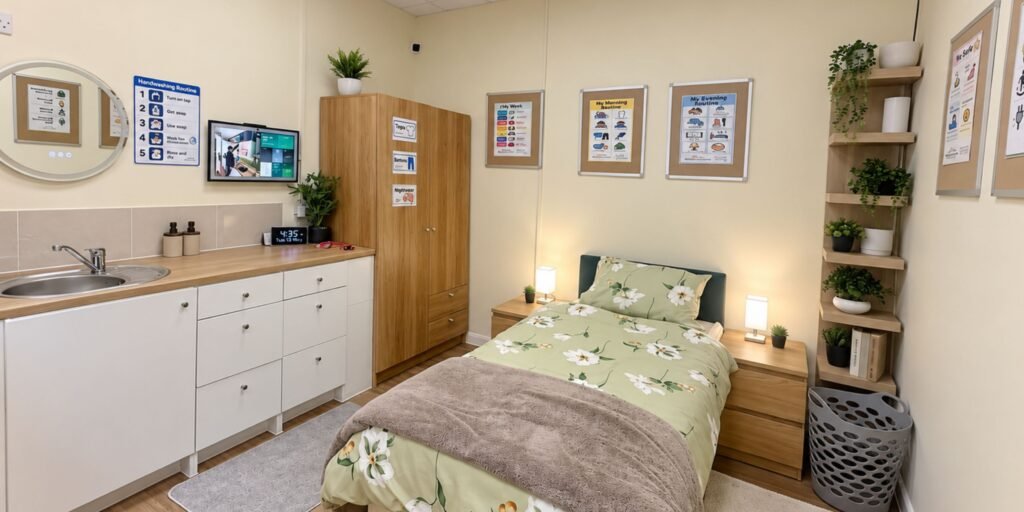
Independence is built through repeated, meaningful practice.
Many everyday tasks look simple only because we have repeated them thousands of times: organising clothes, making a bed, remembering a routine, putting laundry in the right place, finding what we need, keeping track of time or responding to a prompt.
For a person with a learning disability, those tasks may involve communication, memory, sequencing, sensory processing, motor skills, confidence and environmental barriers. The ILTR gives us a safe place to break those challenges down and ask a practical question: what would help this person complete more of the task for themselves?
INNOVATION PRINCIPLETechnology is not the outcome.
A smart light, sensor, screen or visual prompt only matters if it increases participation, reduces unnecessary staff prompting, improves safety or helps a person complete a meaningful routine more independently.
A demonstration lab built around everyday life.

Realistic environment
Household furniture, storage, sink and routines create a setting that feels relevant to everyday life rather than a classroom simulation.
Visual structure
Labels, prompts, sequencing and environmental cues can make information easier to understand and reduce reliance on verbal instruction.
Assistive technology
Voice assistance, smart lighting, sensors, reminders and connected devices can be trialled where they have a clear purpose.
Evidence of progression
The room provides a controlled environment in which the same task can be introduced, practised, adjusted and observed over time.
Everyday routines become learning opportunities.
Clothing & organisation
Locating clothes, sorting items, using labelled storage, choosing appropriate clothing and returning items to the correct place.

Personal routines
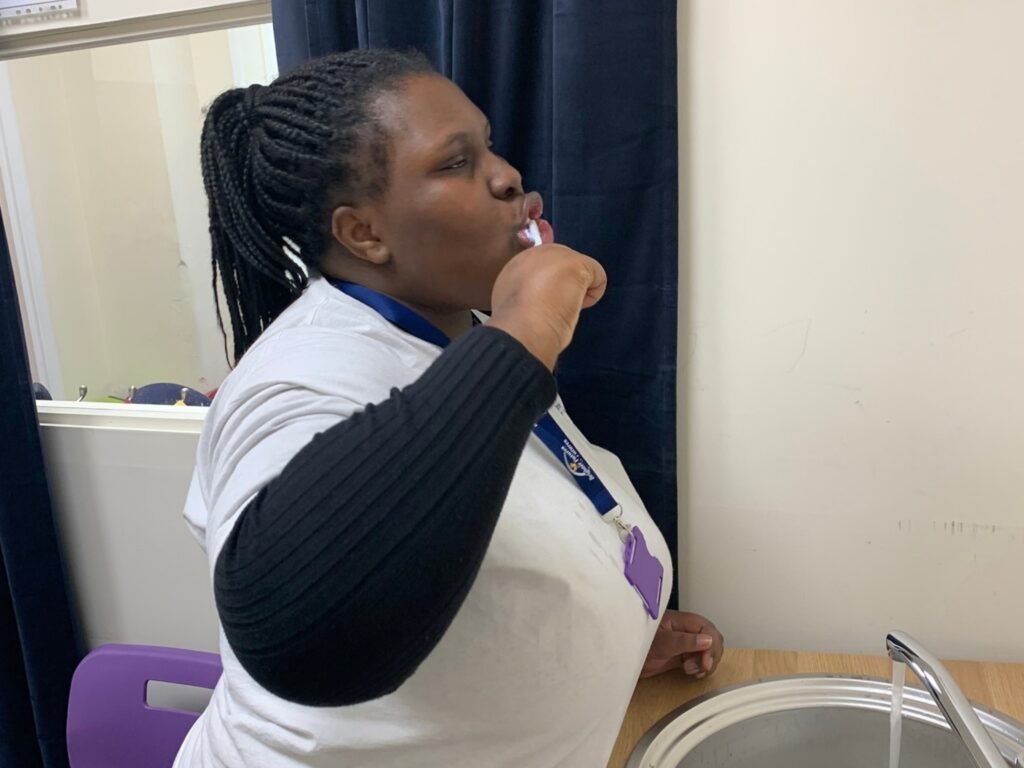
Using visual prompts or environmental cues to support agreed hygiene, grooming or morning/evening routines.
Laundry
Sorting clothing, using a laundry basket, following a sequence and taking greater responsibility for clothing care.

Room care
Making a bed, tidying, cleaning surfaces and understanding where household items belong.

Time & reminders
Using clocks, screens, voice assistants or prompts to support awareness of routines and next steps.

Safety & confidence
Learning how to use everyday equipment safely, recognise environmental cues and ask for support where needed.

Introduce → Supported → Practising → Independent
The same four-stage framework used across our wider Life Skills thinking is particularly powerful in the ILTR because the environment and task can be repeated.
Introduce
Experience the environment, task and any prompts or technology.
Supported
Complete steps with the level of guidance required.
Practising
Repeat the routine with reduced prompting or better use of environmental supports.
Independent
Complete the agreed task, or meaningful parts of it, with minimal direct staff intervention.
From “used the room” to “needed less support”.
A strong ILTR case study should not say only that someone enjoyed the room. It should identify the starting point, the barrier, the adaptation or teaching approach, how support changed and what the person was able to do afterwards.
Illustrative structure – replace with a real consented journey
Starting point: required repeated verbal prompts to organise clothing.
Approach: simplified wardrobe layout, consistent labels, visual sequence and repeated practice.
Progress: began locating items using environmental prompts with fewer verbal instructions.
Outcome: completed agreed parts of the clothing routine with reduced direct prompting.

Designed as a premium demonstration space.
The first ILTR brings together accessible storage, visual prompts, hygiene aids, lighting, smart technology and a realistic independent-living setup. Final website photography should document the finished room and, more importantly, show it being used.
Accessible storage
Organised wardrobe and external shelving designed to make items visible, understandable and easier to return to their place.
Visual prompts
Labels and bespoke prompt boards that support sequencing and reduce reliance on spoken instructions alone.
Smart environment
Connected lighting, voice assistance, sensors and plugs can be used to test practical independence scenarios.
Hygiene & self-care
Sink area, mirror and relevant aids create opportunities to practise personal routines in a realistic setting.
The first room should generate the evidence for what comes next.
Our ambition is to develop the ILTR beyond a single funded refurbishment. We want to understand which environmental adaptations, teaching strategies and technologies make a meaningful difference for different people, and use that learning to strengthen future environments.
Future phases could include a broader range of domestic tasks, more structured assessment and evidence tools, additional assistive-technology trials, partner demonstrations, family/professional learning and replication of successful approaches.
The strongest funding proposition will be evidence-led: what we built → who used it → what changed → what we learned → what Phase 2 will test or enable.
PARTNER WITH THE ILTRWe are interested in more than donations.
Potential partners may contribute technology, research/evaluation expertise, design, occupational therapy insight, accessible products, funding or opportunities to test and improve the model.